ll Businesse
Small business owners wear too many hats.
You manage sales, customers, staff, operations, and cash flow. Then Small Business Bookkeeping Services gets pushed to the side until VAT deadlines arrive, receipts go missing, or the numbers stop making sense.
That is where professional bookkeeping services UK make a real difference.
A reliable bookkeeping service keeps your finances organised, your reports accurate, and your business compliant with HMRC. More importantly, it gives you clarity. You know what is coming in, what is going out, and where your business stands every month.
In this guide, we explain:
- What small business bookkeeping services include
- What happens during a monthly bookkeeping service
- The difference between bookkeeping and accounting
- When to outsource bookkeeping
- How bookkeeping supports VAT returns and year-end accounts
- What to expect from outsourced bookkeeping services UK
If you are searching for reliable, scalable, and accurate bookkeeping support, this guide by Decimal Accountancy will help you understand exactly what your business needs.
What Are Bookkeeping Services?
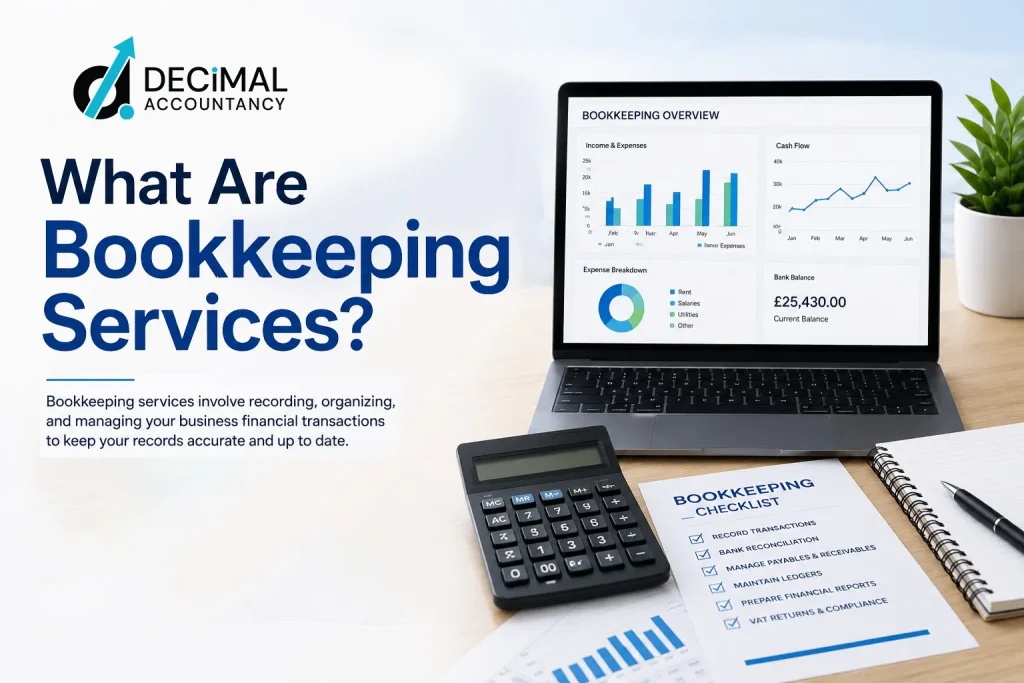
Bookkeeping is the process of recording, organising, and managing your business finances.
Every payment, expense, invoice, and bank transaction needs to be tracked properly. Without accurate bookkeeping, it becomes difficult to understand your cash flow, prepare taxes, or make informed business decisions.
Professional bookkeeping services UK help businesses:
- Stay financially organised
- Maintain accurate records
- Prepare for VAT returns
- Reduce accounting errors
- Improve cash flow visibility
- Stay compliant with HMRC requirements
Bookkeeping is the financial foundation of every successful business.
What Do Small Business Bookkeeping Services Include?
Many bookkeeping companies explain bookkeeping in general terms but never explain what they actually do each month.
Here is what professional small business bookkeeping services should include.
Recording Income and Sales
Every sale your business makes should be recorded accurately.
This includes:
- Customer invoices
- Online sales
- Bank payments
- Card payments
- Cash transactions
Proper income tracking helps business owners understand revenue trends and maintain accurate reporting.
Recording Expenses
Business expenses need to be organised correctly.
This includes:
- Supplier payments
- Office costs
- Travel expenses
- Software subscriptions
- Marketing expenses
- Utilities and rent
Correct expense categorisation improves financial reporting and helps support allowable tax deductions.
Bank Reconciliation
Bank reconciliation is one of the most important parts of bookkeeping.
Your bookkeeper compares your bookkeeping records against your actual bank account transactions.
This process helps identify:
- Missing transactions
- Duplicate entries
- Incorrect amounts
- Unrecorded payments
Regular reconciliation keeps your financial records accurate and reliable.
Invoice Management
Bookkeeping services often include invoice tracking and accounts receivable support.
This helps businesses:
- Monitor unpaid invoices
- Track overdue payments
- Improve cash flow
- Reduce payment delays
Late payments can create major cash flow issues for small businesses. A structured bookkeeping process helps reduce that risk.
Payroll Journals
If your business runs payroll, payroll journals should be recorded correctly inside your bookkeeping system.
This includes:
- Employee wages
- PAYE tax
- National Insurance
- Pension contributions
Accurate payroll entries help keep financial reports aligned with payroll records.
Monthly Financial Reports
A quality monthly bookkeeping service should provide simple, easy-to-understand reports.
These often include:
- Profit and loss report
- Cash flow summary
- Expense breakdown
- Income overview
Good reporting helps business owners make smarter financial decisions.
Monthly Small Business Bookkeeping Services Explained
Many businesses pay for bookkeeping without fully understanding the process behind it.
Here is what a professional monthly bookkeeping service usually looks like.
Week 1: Transaction Collection
The first step is collecting financial data.
This may include:
- Importing bank transactions
- Uploading receipts
- Recording sales
- Reviewing payment platforms
Cloud accounting software often automates much of this process.
Week 2: Expense Processing
Transactions are reviewed and categorised.
This includes:
- Supplier invoices
- Operating expenses
- Subscription payments
- Business purchases
Proper categorisation improves reporting accuracy.
Week 3: Reconciliation and Review
The bookkeeping team reconciles accounts and reviews the data.
This stage helps identify:
- Errors
- Missing transactions
- Duplicate entries
- Incorrect VAT treatment
Regular reviews prevent larger issues later.
Week 4: Reporting and Support
Once records are updated, reports are prepared.
Business owners can review:
- Revenue trends
- Spending patterns
- Cash flow performance
- Business profitability
Some bookkeeping providers also offer guidance and recommendations based on the reports.
How Often Should Bookkeeping Be Updated?
One of the most common questions business owners ask is how often bookkeeping should be done.
The answer depends on transaction volume and business complexity.
Monthly Small Business Bookkeeping Services
Suitable for:
- Small service businesses
- Freelancers
- Startups
- Businesses with lower transaction volume
Monthly bookkeeping is the minimum standard most businesses should maintain.
Weekly Bookkeeping
Suitable for:
- Growing businesses
- Retail businesses
- Agencies
- Businesses managing regular invoices and supplier payments
Weekly updates provide better financial visibility.
Real-Time Cloud Bookkeeping UK
Modern cloud bookkeeping UK systems allow businesses to update records in near real time.
This works especially well for:
- eCommerce businesses
- High-volume companies
- Businesses with multiple payment platforms
Cloud bookkeeping reduces manual work and improves reporting speed.
Bookkeeping vs Accounting
Many people use bookkeeping and accounting interchangeably, but they are different services.
Bookkeeping
Bookkeeping focuses on:
- Recording transactions
- Organising financial records
- Managing day-to-day financial data
Accounting
Accounting focuses on:
- Reviewing financial performance
- Preparing year-end accounts
- Tax planning
- Filing returns
- Business forecasting
Bookkeeping creates accurate financial data. Accounting uses that data for analysis and compliance.
Without good bookkeeping, accounting becomes slower, more expensive, and less reliable.
When Should You Outsource Bookkeeping?
Many businesses start by managing bookkeeping internally.
As the business grows, bookkeeping becomes harder to manage.
This is when businesses often move to outsourced bookkeeping services UK.
You Spend Too Much Time on Admin
Bookkeeping takes time away from running your business.
Outsourcing allows you to focus on growth instead of paperwork.
Your Books Are Behind
Late bookkeeping creates stress and confusion.
Businesses often struggle with:
- Missing receipts
- Unreconciled accounts
- VAT mistakes
- Incomplete records
Professional support helps clean up and maintain your books.
You Need Better Financial Visibility
Accurate reports help businesses:
- Understand profitability
- Track cash flow
- Control spending
- Make faster decisions
Without updated bookkeeping, business owners often operate without clear financial visibility.
VAT Is Becoming Difficult to Manage
VAT errors can lead to penalties and reporting issues.
Professional bookkeeping services help businesses maintain accurate VAT records throughout the year.
Your Business Is Growing
Growth increases financial complexity.
More transactions, more invoices, and more staff require stronger financial systems.
Outsourcing bookkeeping helps businesses scale more efficiently.
How Bookkeeping Supports VAT Returns
VAT reporting depends on accurate bookkeeping.
A bookkeeping service helps by:
- Tracking VAT on purchases and sales
- Applying correct VAT codes
- Maintaining organised transaction records
- Preparing reports for submission
This reduces errors and helps businesses remain compliant.
Businesses that fall behind on bookkeeping often struggle with VAT deadlines and reporting accuracy.
How Bookkeeping Supports Year-End Accounts
Year-end accounting becomes easier when bookkeeping is accurate throughout the year.
Your accountant uses bookkeeping records to prepare:
- Financial statements
- Corporation tax returns
- Self-assessment filings
- Business reports
Clean bookkeeping provides:
- Faster year-end preparation
- Lower accounting costs
- Fewer corrections
- Better financial accuracy
Good bookkeeping saves time for both business owners and accountants.
What Makes a Good Bookkeeping Service?
Not all bookkeeping providers offer the same level of service.
A strong bookkeeping partner should provide:
Clear Communication
You should understand:
- What is included
- What happens monthly
- What reports you receive
- What support is available
Cloud Accounting Support
Modern businesses need digital bookkeeping systems.
Cloud accounting allows:
- Real-time reporting
- Automated bank feeds
- Faster collaboration
- Better document management
Accurate Reporting
Reports should be simple, clear, and useful.
Business owners should easily understand:
- Revenue
- Expenses
- Cash flow
- Profitability
Scalability
Your bookkeeping system should grow with your business.
The right provider supports businesses as transaction volume increases.
Benefits of Outsourced Bookkeeping Services UK
Choosing professional outsourced bookkeeping services UK offers several advantages.
Save Time
Business owners spend less time on admin work.
Reduce Errors
Professional bookkeeping improves accuracy.
Improve Cash Flow Visibility
Regular reports help businesses understand their financial position.
Stay HMRC Compliant
Accurate records support VAT returns and year-end reporting.
Support Business Growth
Better financial visibility leads to better decisions.
Frequently Asked Questions – FAQ
Bookkeeping services usually include transaction recording, bank reconciliation, expense tracking, invoice management, payroll journals, and monthly reports.
Pricing depends on transaction volume, business size, and service scope. Many providers offer fixed monthly packages.
Bookkeeping records financial transactions. Accounting analyses those records and prepares reports and tax filings.
Many small businesses outsource bookkeeping to save time, improve accuracy, and maintain compliance.
Most businesses should update bookkeeping monthly at minimum. Growing businesses often benefit from weekly updates.
Bookkeeping Onboarding Checklist
When starting with to subscribe to bookkeeping services with Decimal Accountancy, businesses usually need:
- Bank account access
- Accounting software access
- Previous bookkeeping records
- VAT information
- Payroll information
- Supplier and customer details
A smooth onboarding process helps bookkeeping services start efficiently.
Final Thoughts
Professional bookkeeping helps businesses stay organised, compliant, and financially informed.
The best bookkeeping services UK do more than record transactions.
They help businesses:
- Understand cash flow
- Maintain accurate records
- Prepare for VAT returns
- Simplify year-end accounting
- Make better financial decisions
If your bookkeeping is behind, inconsistent, or taking too much time, outsourcing may be the right next step.
Reliable small business bookkeeping services can help your business operate more efficiently and scale with confidence.
Need Professional Bookkeeping Support?
- Book a bookkeeping review
- Get a fixed-fee quote
- Ask us to clean up your bookkeeping
- Speak with a bookkeeping specialist today
Take control of your business finances with reliable and professional bookkeeping support.